What if the most dangerous mistake in a DeFi portfolio is not choosing the wrong protocol, but misunderstanding what a transaction will do before signing it? For a US-based user, a dashboard may show balances across lending markets, liquidity pools, staking contracts, and multiple networks. Yet the displayed portfolio is only a snapshot of outcomes. It may not reveal an approval that remains active, a hidden fee, a change in token exposure, or a contract interaction whose risk is difficult to infer from a short wallet prompt. The central lesson is simple but easy to miss: portfolio tracking and transaction security are not separate tasks. They are two views of the same operational problem.
Consider a hypothetical investor, Maya, who holds assets on Ethereum and an Ethereum-compatible network. She supplies a stablecoin to a lending protocol, deposits another token into a liquidity pool, and keeps a small balance for transaction fees. Her portfolio tracker reports a healthy total value. Then she decides to move funds into a new yield strategy. The transaction appears routine, but the economic result depends on several layers: which contract receives permission to spend her tokens, which assets she will receive, how exchange rates are calculated, what fees apply, and whether the protocol can be paused or upgraded. A portfolio balance tells Maya where she stands. It does not, by itself, tell her what she is about to authorize.
The portfolio is a map, not a risk model
DeFi portfolio tracking is often treated as an accounting exercise. The user wants to know how many tokens are held, where they are deposited, and how the total value changes over time. That information is useful, but it can create a false sense of completeness. A tracker usually observes on-chain positions and estimates their market value; it does not automatically understand every economic dependency behind those positions.
A position in a lending protocol is not equivalent to a token sitting in a wallet. It may represent a claim mediated by smart contracts, with risks related to collateral, liquidation, oracle pricing, interest-rate changes, and protocol design. A liquidity-provider position is more complicated still. Its value can shift because the pool composition changes, and the user may experience impermanent loss even when fees are being earned. The visible portfolio number compresses these mechanisms into one figure.
This leads to a useful distinction: exposure is what can affect the value of a position, while authority is what a wallet or contract is permitted to do. Portfolio trackers are generally stronger at displaying exposure. Wallet security controls are more concerned with authority. An approval, for example, may give a contract permission to spend a token without immediately changing the portfolio balance. That permission is nevertheless part of the user’s security state.
The distinction matters because an attacker does not need to steal a seed phrase to cause damage. A malicious website, compromised front end, deceptive token, or manipulated transaction request may attempt to persuade a user to authorize an unsafe action. The risk is not merely “the wallet was hacked.” It may be that the user signed a valid transaction whose consequences were obscured.
Transaction simulation turns intent into a testable question
Transaction simulation is valuable because it moves the review process closer to the question users actually care about: “If I sign this, what changes?” Instead of relying only on a function name or a polished interface, a simulation can help preview expected balance changes, token transfers, approvals, and contract effects. It is not a guarantee of safety, but it can expose a mismatch between the user’s intention and the transaction assembled by an application.
Imagine Maya expects to deposit 1,000 units of a stablecoin into a lending market. A review that shows the stablecoin leaving her wallet and a corresponding lending position appearing is broadly consistent with her intention. A review that also shows a large allowance, an unexpected token transfer, or interaction with an unfamiliar contract should interrupt the workflow. The simulation has not proven that the protocol is sound. It has performed something more modest and immediately practical: it has made the proposed state change easier to inspect.
That limitation is important. Simulation depends on the state used for the preview, the behavior of the contracts involved, and the assumptions of the simulation system. Conditions can change between simulation and execution. Some contract behavior may depend on timing, external data, later transactions, or paths that are difficult to model perfectly. A clean simulation therefore reduces one class of uncertainty; it does not remove smart-contract risk, market risk, governance risk, or user error.
For advanced users, the best mental model is not “simulation equals approval.” It is “simulation is a pre-flight check.” Pilots still inspect conditions after instruments report normal readings. Similarly, a DeFi user should compare the simulated result with the economic purpose of the transaction, the identity of the contract, the network selected, and the permissions being granted.
Why wallet context improves portfolio decisions
A portfolio tracker becomes more useful when it is connected to the actions that create and change positions. Suppose a user sees that a particular token represents a growing share of the portfolio. The next question is not simply whether the percentage is high. It is why. Is the increase caused by price appreciation, borrowed funds, reward emissions, an accumulating claim token, or a change in pool composition? Each explanation implies a different risk.
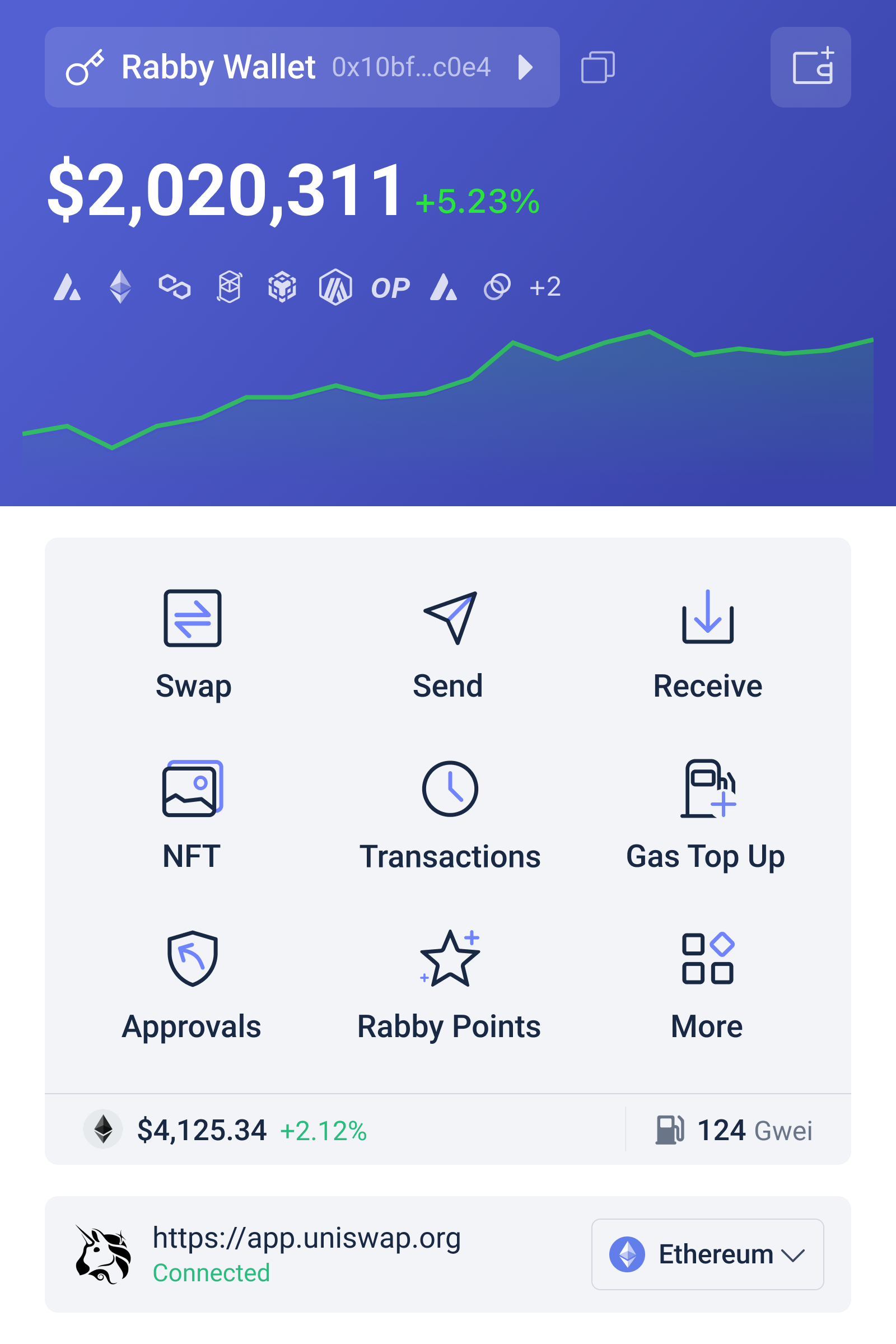
This is where an advanced wallet can serve as a control surface rather than merely a key holder. A security-oriented workflow should help the user inspect the network, the destination contract, the assets involved, and the expected result before signing. Users exploring an advanced rabby wallet workflow should treat these features as part of portfolio management: the objective is not only to see assets, but to understand how future permissions and transactions may alter them.
There is also a behavioral advantage. When transaction details are legible, users are less dependent on habit. Blindly approving a familiar-looking prompt is dangerous because familiarity with an application is not proof that the current transaction is safe. A wallet that surfaces warnings or simulated outcomes can create a useful pause between intention and authorization. That pause is operationally significant, particularly when transactions involve unfamiliar protocols, bridges, token approvals, or newly deployed contracts.
A reusable framework for safer DeFi activity
Before signing, a user can evaluate a transaction through five questions. First, what is leaving the wallet? Identify the token, amount, and network. Second, what is expected to arrive? If nothing meaningful arrives, determine whether the transaction is an approval, a claim, a contract call, or a fee payment. Third, who receives authority? Distinguish a one-time allowance from a broad or persistent permission. Fourth, what changes in the portfolio? Consider leverage, liquidity, lockups, pool exposure, and the possibility that a token received is merely a representation of a claim. Fifth, what remains uncertain? Mark risks that a wallet cannot evaluate, including protocol economics, oracle failure, governance decisions, and market liquidity.
This framework also clarifies when portfolio tracking can mislead. A rising dollar value may reflect volatile token prices rather than improved financial resilience. A high displayed yield may compensate users for inflationary rewards, smart-contract risk, or illiquidity. A diversified list of tokens may still be concentrated if many assets depend on the same chain, stablecoin, oracle, bridge, or lending market. Diversification by ticker is not necessarily diversification by failure mode.
For US users, record keeping adds another practical layer. On-chain activity may involve swaps, liquidity provision, staking, lending, borrowing, and reward claims, each with different economic interpretations. A portfolio tracker can organize activity, but the user should preserve transaction records and understand that software classifications are not automatically a tax conclusion. The correct treatment can depend on facts and applicable rules, so tracking tools should support review rather than replace professional judgment.
What to watch as DeFi interfaces mature
If transaction previews become more accurate and portfolio tools become more protocol-aware, the boundary between a wallet and a risk dashboard may continue to narrow. The likely benefit would be better alignment between what users think they are doing and what smart contracts will actually execute. The unresolved question is how much interpretation can safely be automated. A system may identify an unusual approval, yet still be unable to judge whether a complex protocol is economically robust.
The most useful future improvements would therefore not be simple confidence scores. They would explain dependencies: which contracts are involved, which permissions persist, how a position changes under stress, and which assumptions produced the estimate. Users should watch for tools that show their reasoning and limitations, not merely tools that issue reassuring labels. Transparent uncertainty is more valuable than a false impression of certainty.
Frequently Asked Questions
Can portfolio tracking prove that a DeFi protocol is safe?
No. Tracking can show balances, positions, and estimated values, but it cannot establish that a protocol’s code, governance, oracle design, incentives, or liquidity will remain reliable. It is an observation tool, not a complete audit or risk guarantee.
What does transaction simulation add to a wallet review?
Simulation can preview likely state changes, such as tokens transferred, assets received, or permissions granted. This helps detect mismatches between the user’s intention and the proposed transaction. It should still be treated as a pre-flight check because blockchain state and contract behavior can change.
Should DeFi users revoke every token approval?
Not automatically. Revoking approvals can reduce persistent authority, but it may add transaction costs and operational friction. The better approach is to review which contracts have spending permission, limit approvals where practical, and remove permissions that are unnecessary or tied to applications no longer in use.
Maya’s original problem was not a lack of data. It was a gap between data and interpretation. A portfolio tracker showed her position; a careful wallet workflow helped her examine the next state change. That combination produces a stronger form of DeFi discipline: observe exposure, inspect authority, simulate intent, and keep the remaining uncertainty visible. In a system built from programmable contracts, security begins before the transaction is signed.